
Alexandre Afgoustidis receives the CNRS Bronze Medal for his work in representation theory
Alexandre Afgoustidis, a CNRS research fellow at the Institut Élie Cartan de Lorraine
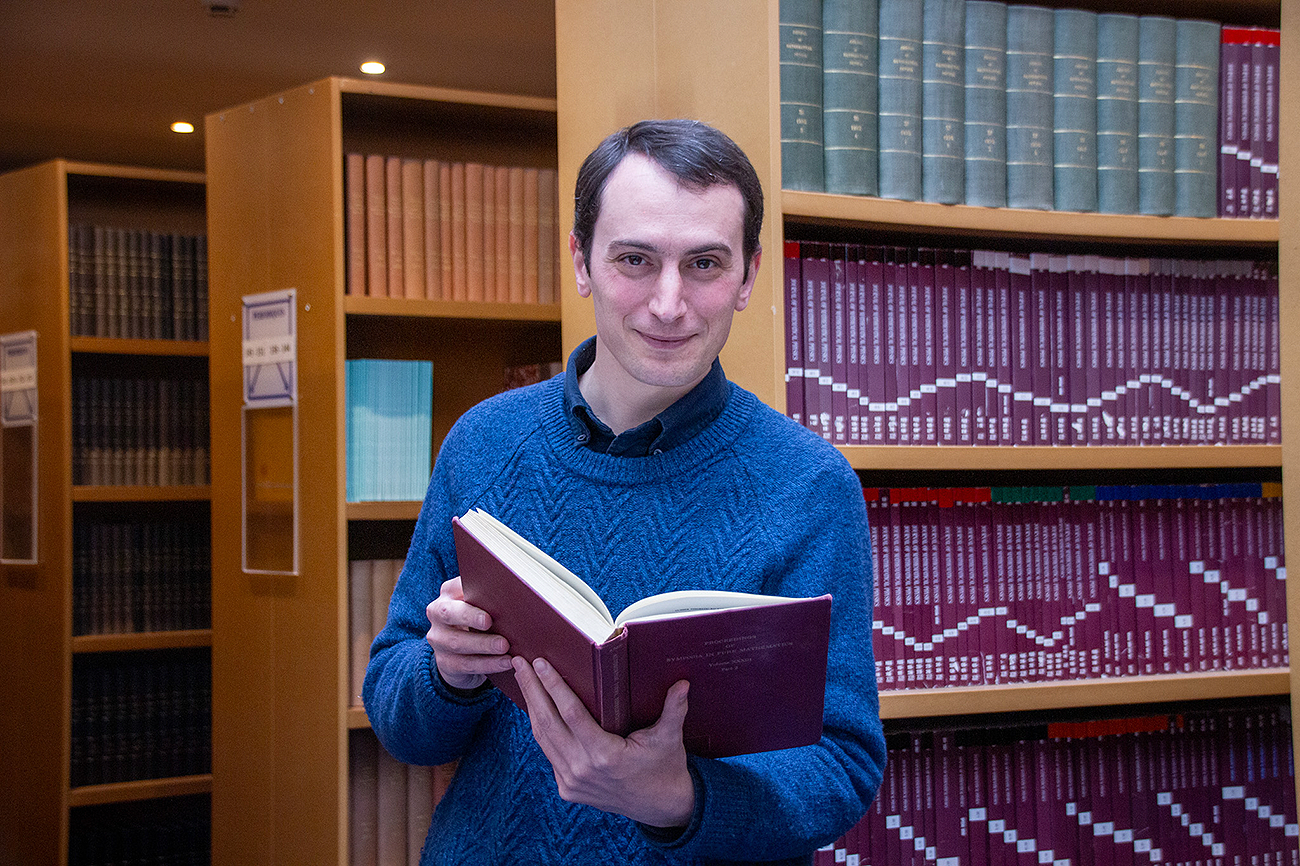
“My educational background isn’t particularly unusual for a French mathematician. In high school, and then at the start of my college years, I liked math, but I wouldn’t say it was my absolute passion ,” says Alexandre Afgoustidis. After attending preparatory classes and then the École normale supérieure de Cachan, he gradually shifted toward research following a thesis at the intersection of mathematics and neuroscience. From 2015 to 2020, he served as an associate professor at Paris-Dauphine University, an experience he describes as “very enriching,” before joining the CNRS in 2020.
His work focuses on the representation theory of Lie groups, a field that uses the concept of symmetry to study mathematical and physical phenomena. He is particularly interested in the representations of real reductive groups and their p-adic variants. “
He thus proposed a new framework, inspired by ideas put forward by George Mackey in the 1970s and further developed by Nigel Higson in the 2000s, that makes it possible to link complex mathematical objects to simpler structures. This work led to a complete construction of Mackey’s correspondence, conjectured since the 1970s, and to a new proof of the Baum-Connes conjecture for real reductive groups. His research also falls within the framework of the Langlands program, where he has helped clarify and resolve questions posed several decades ago.
“The further I go, the further I move away from what are usually called concrete applications,” observes the researcher, while emphasizing the deep unity of mathematics and the connections between its various branches. “It’s like the weather: there are people who use mathematics to predict what the weather will be like… and others who aren’t directly involved in the predictions, but who improve the mathematics behind those predictions,” he concludes.
The CNRS Bronze Medal recognizes the entirety of his contributions, as well as his commitment to sharing knowledge and the collaborative spirit of research. He accepts this honor with humility, seeing it above all as “an encouragement to keep trying to be useful.”