
A dozen French mathematicians, or mathematicians working in France, winners of the 2025 Frontiers of Science Prize
International
Distinctions
The International Congress on Fundamental Sciences will be held in Beijing from July 13 to 25, 2025. Once again, this annual event will bring together renowned experts from around the world to celebrate the fundamental sciences: mathematics, physics, computer science, and engineering.
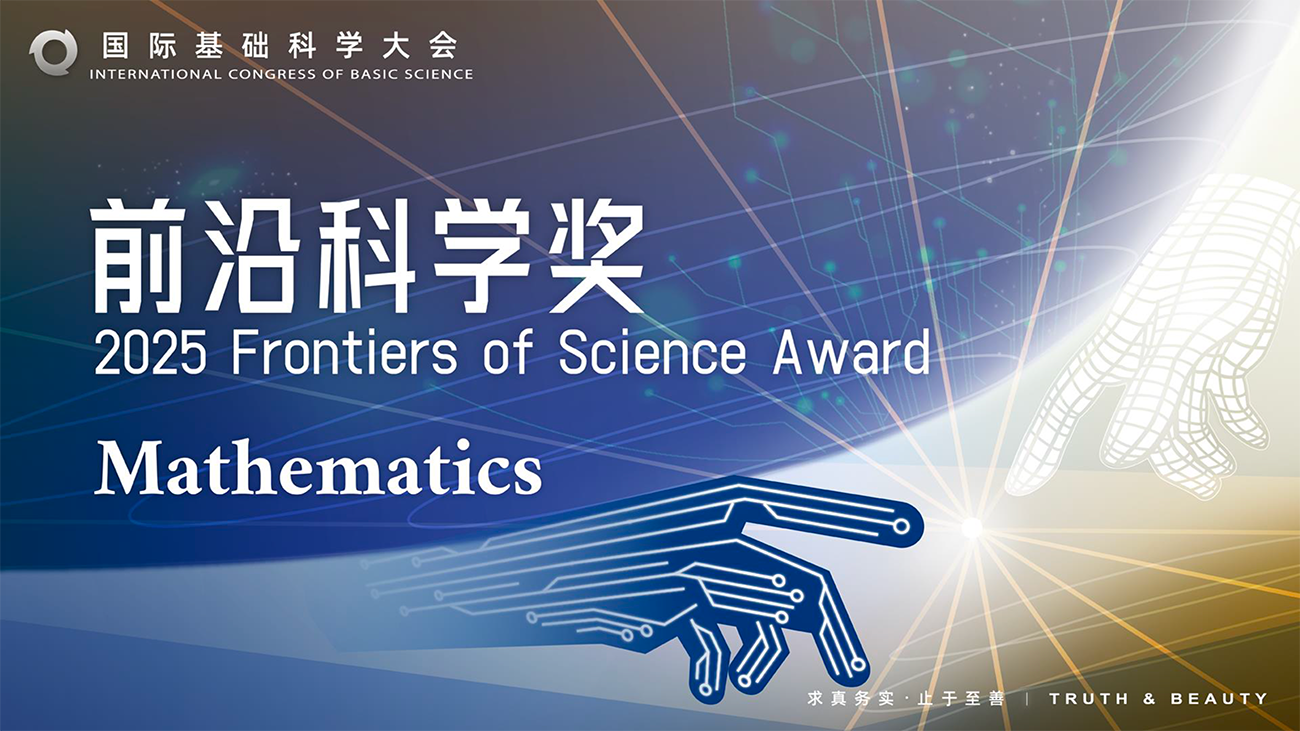
The opening ceremony and awards presentation will take place on July 13. The Frontiers of Science Award is given to recent articles recognized for a major advance in their field. The scientific work must meet the following three criteria:
- have been published within the last ten years
- be of high scientific value and originality
- have been evaluated and accepted by researchers in the field
Ce prix a notamment pour objectif d'encourager les jeunes chercheuses et chercheurs à explorer les frontières de la science fondamentale.
Les lauréats de la communauté mathématique française
Discrete Geometry and Graph Theory
- Charles Bordenave, de l’Institut de Mathématiques de Marseille et Benoît Collins, de l’Université de Kyoto, pour leur article « Eigenvalues of random lifts and polynomials of random permutation matrices ».
Symplectic and Differential Topology
- Vincent Humilière et Sobhan Seyfaddini, de l’Institut de Mathématiques de Jussieu - Paris Rive Gauche, pour l’article « Proof of the simplicity conjecture » co-écrit avec Daniel Cristofaro-Gardiner, de l’Université du Maryland.
Probability Theory and Stochastic Analysis
- Rémi Rhodes de l’Institut de Mathématiques de Marseille et Vincent Vargas, du Département de Mathématiques et Applications, pour leur article « Integrability of Liouville theory: Proof of the Dozz formula » co-écrit avec Antti Kupiainen, de l’Université de Helsinki.
One and Several Complex Variables
- Andreas Höring, du Laboratoire Jean Alexandre Dieudonné, pour l’article « Minimal models for Kähler threefolds », co-écrit avec Thomas Peternell, de l’Université de Bayreuth.
General Relativity
- Jérémie Szeftel, du Laboratoire Jacques-Louis Lions, pour l’article « Kerr stability for small angular momentum », co-écrit avec Sergiu Klainerman, de l’Université de Princeton.
Mathematics of String Theory and Condensed Matter
- Maxim Kontsevich, de l'Institut des Hautes Études Scientifiques, pour l’article « Algebra of the infrared and secondary polytopes », co-écrit avec Yan Soibelman (Kansas State University) et Mikhail Kapranov (Kavli IPMU, University of Tokyo).
Ordinary Differential Equations, Special Functions and D-Modules
- Vadim Schechtman, de l’Institut de mathématiques de Toulouse, pour l’article « Perverse sheaves over real hyperplane arrangements », co-écrit avec Mikhail Kapranov (Kavli IPMU, University of Tokyo).
- Claude Sabbah, du Centre de Mathématiques Laurent Schwartz de l'École polytechnique, pour l’article « Relative regular Riemann-Hilbert correspondence II », co-écrit avec Luisa Fiorot (University of Padua) et Teresa Monteiro Fernandes (University of Lisbon).
- Javier Fresán, de l’Institut de Mathématiques de Jussieu - Paris Rive Gauche et Claude Sabbah, du Centre de Mathématiques Laurent Schwartz de l'École polytechnique, pour l’article « Hodge theory of Kloosterman connections », co-écrit avec Jeng-Daw Yu (National Taiwan University).