Marco Mazzucchelli Awarded Fellowship at the Institute for Advanced Study
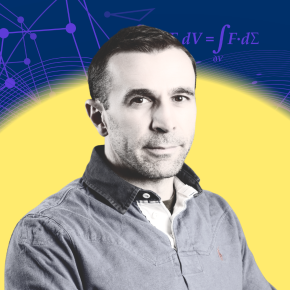
Marco Mazzucchelli, CNRS researcher at Institut de Mathématiques de Jussieu - Paris Rive Gauche 1 has been selected as a Member of the Institute for Advanced Study (IAS) in the School of Mathematics for the 2026-2027 academic year.
- 1
CNRS/Sorbonne Université
This prestigious membership allows for focused research and the free and open exchange of ideas among an international community of scholars at one of the foremost centers for intellectual inquiry.
Marco Mazzucchelli works in dynamical systems, symplectic topology, and Riemannian geometry. During his stay, he will work on questions concerning periodic orbits, more general invariant sets, and the complexity of Hamiltonian systems.
Each year, IAS welcomes more than 250 of the most promising post-doctoral researchers and distinguished scholars from around the world to advance fundamental discovery as part of an interdisciplinary and collaborative environment. Visiting scholars are selected through a highly competitive process for their bold ideas, innovative methods, and deep research questions by the permanent Faculty, all of whom are preeminent leaders in their fields. Past IAS Faculty include Albert Einstein, Erwin Panofsky, John von Neumann, Hetty Goldman, George Kennan, and J. Robert Oppenheimer.
Located in Princeton, NJ, the Institute for Advanced Study was established in 1930. Today, research at IAS is conducted across four Schools—Historical Studies, Mathematics, Natural Sciences, and Social Science—to push the boundaries of human knowledge.
Among past and present scholars, there have been 37 Nobel Laureates, 49 of the 68 Fields Medalists, and 25 of the 29 Abel Prize Laureates, as well as MacArthur and Guggenheim fellows, winners of the Turing Award and the Wolf, Holberg, Kluge, and Pulitzer Prizes.