Over 1 million contributions to the citizen consultation on mathematics
Organized by CNRS Mathematics from March 10 to April 30, 2025, the online questionnaire “Aux maths citoyennes, citoyens ! Grande consultation nationale” (Citizens, get involved in math! Major national consultation) gathered more than 1.1 million contributions from over 33,000 participants. This was a historic success for an unprecedented initiative in science, with the overall results to be published in fall 2025.
1.1 million contributions
Thanks to an exceptional mobilization of citizens, this consultation brought together more than 33,000 participants, who expressed more than 365,000 verbatim comments and more than 1 million contributions. The anonymous online questionnaire consisted of around 20 questions and took 5 to 15 minutes to complete. Aimed at everyone, the goal was to gather citizens' perceptions and desires regarding mathematics. The results are currently being analyzed and will be presented to the Senate in the fall of 2025.
The CNRS wants to “understand why we often hear ‘I hated maths’”
During Mathematics Week, Christophe Besse, director of CNRS Mathematics, and lead coordinator of the “Aux maths citoyennes et citoyens” (Citizens, get invovled in maths !) project, will be the guest on the 6:20 a.m. show. More info: https://www.radiofrance.fr/franceinte...
Audiodescription
33,421 participants
With over 33,000 participants, there was a relatively even distribution across genders and age groups. However, the most represented professional categories were executives and higher intellectual professions. The Ile-de-France region has the highest number of participants, followed by Haute-Garonne and Auvergne-Rhône-Alpes. This is an online questionnaire, a snapshot in time, which is highly informative, but the responses do not correspond to a representative sample of society and the overall results should not be taken as such.
 |  |

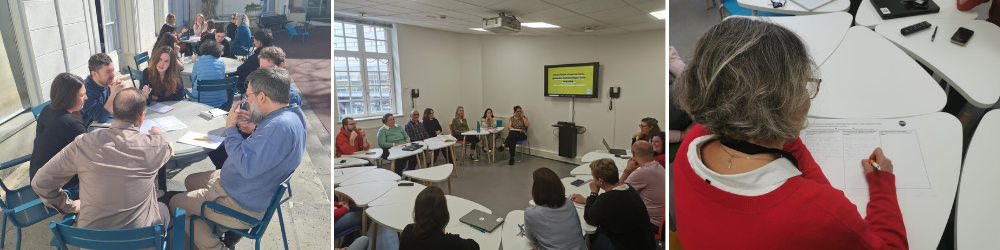
Around thirty face-to-face workshops
In parallel with the online questionnaire, around thirty workshops were organized to bring together interested or curious individuals in person. Lasting between 30 and 90 minutes, the aim of these workshops was to facilitate group discussions in order to gather perceptions and experiences of mathematics.
An online and local presence
A communication campaign ran throughout the consultation period, covering digital media, social networks, the media, and posters. The press and digital components (including a display campaign and a social media campaign) were given high priority.
Influencers were also mobilized to share their own relationships with mathematics and encourage their communities to participate in the consultation.
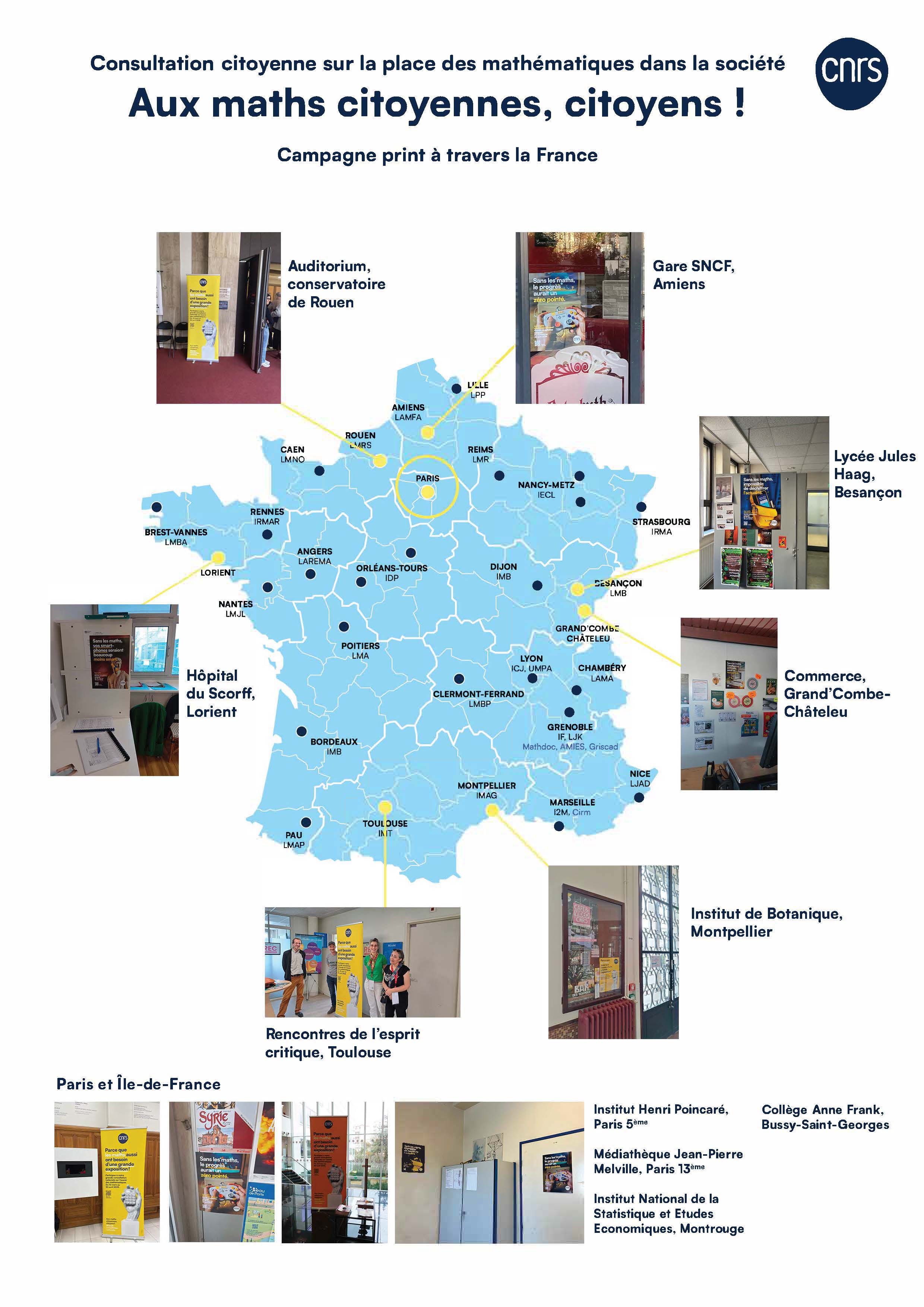
The campaign's posters and kakemonos were displayed throughout the country, from bakeries to mathematics laboratories, libraries, hair salons, and numerous events.
What next?
The results are currently being analyzed and will feed into the work of two panels of citizens who will meet for six days/three full weekends between June and July.
The panels will focus on issues of access to mathematics for all throughout life. With this in mind, they will be made up of people who are particularly affected by forms of exclusion related to mathematics. One panel will be composed exclusively of women, representative of the diversity of the French population, in order to reflect on issues of access in a single-sex environment. The other will bring together people from modest socio-professional backgrounds and rural areas. These two groups will work in parallel, while benefiting from joint discussion time to share their thoughts and enrich the debate.