
The CNRS-Pauli Institute in Vienna: 20 Years of Scientific Cooperation Between France and Austria
Founded in 2004 in Vienna, the CNRS Pauli Institute (ICP) is an international CNRS research laboratory dedicated to mathematics, computer science, and physics. Hosted by the Wolfgang Pauli Institute (WPI), it has served for over twenty years as a premier venue for scientific exchange between France and Austria, fostering interdisciplinary collaborations and welcoming visiting researchers. It was renewed for the 5th time in January 2026.
Structured collaborations dating back to the 2000s
In the early 2000s, several initiatives emerged to foster scientific collaboration between France and Austria. In 2002, a broad European research training network was established by coordinator Norbert J. Mauser: HYKE (EU Research Training Network “HYperbolic and Kinetic Equations”). Organized around 16 scientific nodes, HYKE brought together 350 researchers in 12 countries, including Benoît Perthame, Pierre-Louis Lions, Claude Bardos, Maria Esteban, François Golse, and Cédric Villani. “What was then the largest European research network in mathematics revolved around the Paris–Vienna axis. It was therefore logical for the CNRS to reinforce this dynamic by creating an International Joint Unit,” explains Norbert J. Mauser, director of the CNRS-Pauli Institute (ICP).
It was within this dynamic that the ICP was created in 2004 as an International Joint Unit
The CNRS-Pauli Institute draws on the WPI’s extensive network of partner institutions: all major Austrian universities participate in this collaboration, enabling French researchers to work at various institutions across the country with the administrative and financial support of the institute.
Testimonial from Emmanuel Royer, Director of the CRM-CNRS IRL (Montreal)
I was assigned for a year to the international research laboratory “Institut CNRS Pauli.” After several years of intense research administration, I felt the need for the time and mental freedom to reconnect with my own research. The extraordinary expatriation opportunity offered by the CNRS made it possible to pursue such a scientific project. It was also important that I could share this experience with my family. The CNRS Pauli Institute, located in the heart of Vienna, Austria, provided the ideal conditions to pursue this dual scientific and family project. Even though my research field is not central to the international laboratory’s Austrian partner, the Wolfgang Pauli Institute, its director Norbert J. Mauser and its administrative director Stefanie Preuss welcomed me warmly and helped facilitate my transition and scientific life in Vienna. I was thus able to take advantage of the great scientific (and cultural…) richness of the city of Vienna, particularly with colleagues from the University of Vienna and the Institute of Science and Technology Austria.
A central hub for international scientific collaboration
Since its inception, the laboratory has served as a hub for the French scientific community seeking to establish collaborations in Austria. Each year, it hosts several long-term visitors, fostering scientific exchange and the flow of ideas between teams in both countries.
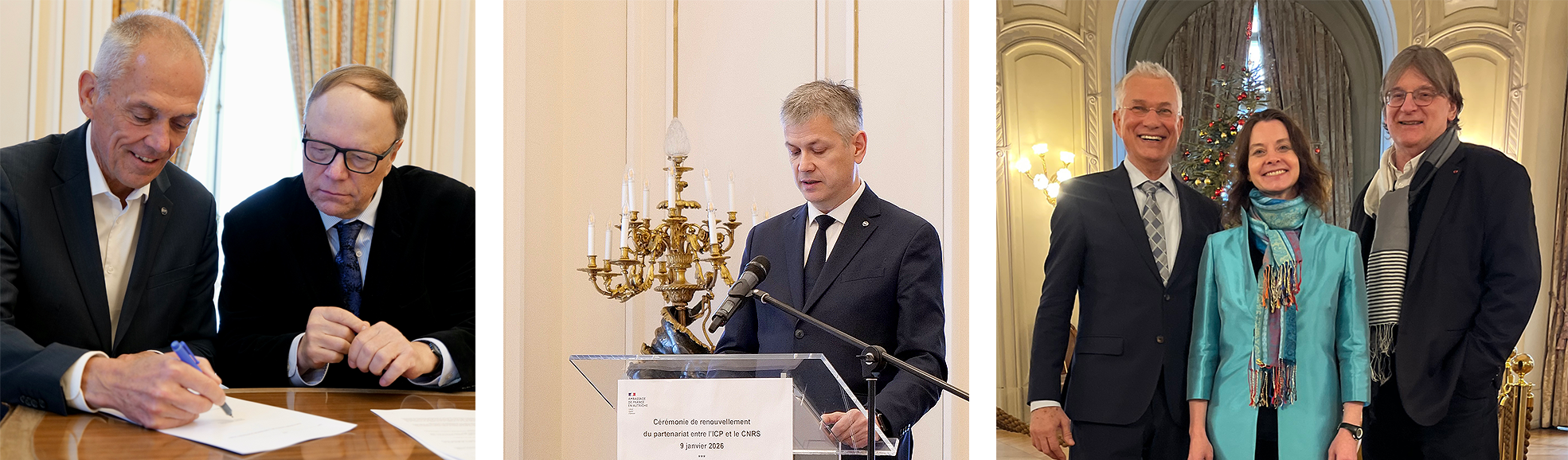
In 2025, the ICP celebrated its 20th anniversary, a milestone that provided an opportunity to reflect on how far it has come since its founding. The celebrations were attended by many guests, including Alain Aspect, winner of the 2022 Nobel Prize in Physics. “Passing the evaluation five times proves that the laboratory has demonstrated its excellence and effectiveness,” emphasized its director. “Recognition from the CNRS also supports the Wolfgang Pauli Institute: the CNRS evaluation is in fact considered very rigorous by the Austrian Ministry of Research, which awards a grant to the institute, intended in particular to co-fund the ICP.” Renewed in January 2026, the laboratory intends to continue its scientific development by strengthening its role as an interface between disciplines and scientific communities.
Watch the video produced by the French Embassy in Austria to mark the occasion
From a scientific perspective, the research conducted at the WPI and the ICP contributes, for example, to the development of mathematics applied to quantum technologies as well as to biology and medicine; the WPI also collaborates with the French National Institute of Health and Medical Research (Inserm). Artificial intelligence is also utilized there as a tool for analysis and research, with an approach aimed at understanding its limitations and errors.
Building on more than twenty years of scientific cooperation, the CNRS Pauli Institute thus continues its mission: to strengthen collaborations between mathematics, computer science, and physics, and to consolidate scientific ties between France and Austria.