Interactive mathematics: a strategic visit by Insmi to IRL Abraham de Moivre
Created in 2018, the Abraham de Moivre International Research Laboratory (IRL) is a joint laboratory between the CNRS and Imperial College London. Its aim is to establish a long-term partnership between the French and British mathematical communities. Renewed in 2024 for a new five-year partnership, the laboratory aims to use mathematical sciences to address societal challenges related to climate, health, and sustainable development. It was in this context that, in October 2025, a meeting between the laboratory and the Institute of Mathematical Sciences and their Interactions (Insmi) took place to explore possibilities for collaboration around the IRL, the PEPR exploratoire Maths-Vives, and the Institute of Mathematics for Planet Earth (iMPT).
The Mathematics in Interaction research program
PEPR Maths-Vives is a research program within the France 2030 plan, with a budget of €50 million over 10 years. The main objective of the program is to support structuring and interdisciplinary research projects, promoting interaction between mathematics and other scientific fields. The program is structured around three thematic areas, enabling the development of interdisciplinary projects with a strong scientific and societal impact.
The Institute of Mathematics for Planet Earth
The iMPT is a scientific interest group whose objective is to initiate projects in which mathematics plays a key role in understanding and modeling the major challenges facing the planet, such as climate, the environment, biodiversity, and natural resources. It brings together researchers from different fields of mathematics and other scientific disciplines to develop predictive models and quantitative methods applied to these issues.
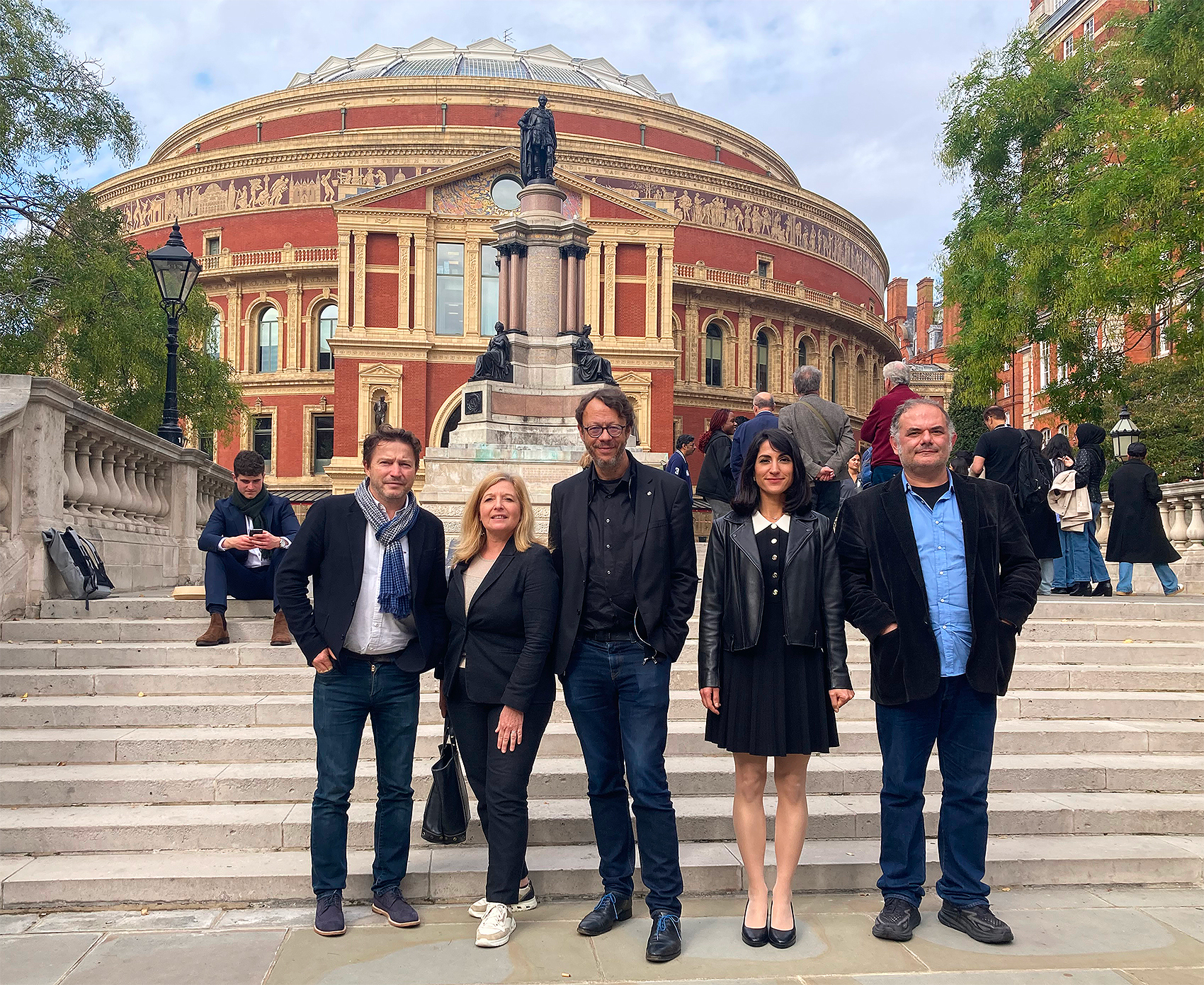
Following this visit, Arnaud Guillin, Deputy Scientific Director at Insmi, Executive Director of iMPT, and Director of PEPR Maths-Vives, and Grigorios Pavliotis, Professor of Applied Mathematics and Director of IRL Abraham de Moivre, discuss the challenges and prospects of this meeting.
What was the purpose of this visit to the Abraham de Moivre IRL?
A.G.: The visit to the Abraham de Moivre IRL was fully in line with the international activities of PEPR Maths-Vives and iMPT, with several complementary objectives. First, to strengthen scientific cooperation between the CNRS and Imperial College. The aim of the visit was to discuss opportunities for collaboration between the two institutions in the field of interactive mathematics. In particular, it involved developing strategic collaborations with the CNRS-Imperial IRC for Transformational Science and Technology and with the “Mathematics for our Future Climate” project, led by Dan Crisan, Professor of Mathematics in the Department of Mathematics at Imperial College London and Director of the EPSRC Centre for Doctoral Training in the Mathematics for our Future Climate: Theory, Data and Simulation (MFC CDT). The aim was to align the PEPR and iMPT's research areas in interactive mathematics with Imperial College's scientific projects in order to maximize their joint scientific impact. One of the goals discussed with Dan Crisan is to promote the mobility of young researchers. The visit provided an opportunity to discuss ways of promoting international mobility for doctoral students within the framework of the PEPR and iMPT.
The second step was to identify and prepare Franco-British collaborative projects. We also wanted to explore projects responding to bilateral or international calls for proposals, in order to structure concrete collaborations.
This visit therefore combined strengthening scientific cooperation, identifying synergies, structuring collaborative projects, promoting the international mobility of young researchers, and promoting initiatives within the framework of the international actions of PEPR Maths-Vives and iMPT, in order to maximize their impact at the international level.
What activities are carried out at the Abraham de Moivre Research Laboratory (IRL) in the field of interactive mathematics?
G.P.: The applications of mathematics to physics, engineering, biology, and other fields are central to the laboratory's mission. The IRL explicitly covers mathematics and its interactions with other disciplines, enabling collaborations that link theory, computation, and science in the field. In practice, this translates into several mechanisms.
First, structured mobility programs that allow researchers and teacher-researchers to spend long periods at Imperial College, and Imperial College academics to spend time in the mathematical units of the CNRS, thus promoting sustainable joint work rather than one-off visits.
Second, thematic workshops and networks bring communities together around topics where mathematics meets applications (e.g., stochastic modeling, algorithms, atmospheric/ocean science, etc.).
Finally, a strategic initiative has been launched for the period 2024-2029 to deepen the links between fundamental mathematics and applications in the fields of artificial intelligence and machine learning, climate and environmental modeling, finance, and health, highlighting the fact that many future technologies depend on mathematical foundations and algorithms.
What are the links between iMPT in France and the Mathematics of Planet Earth program in the United Kingdom?
G.P.: At Imperial College, the Mathematics for our Future Climate (MPE) program is a research group led by my colleague Dan Crisan, which develops mathematical modeling tools to study the Earth, its capacity to support life, and the impact of human activities. The MPE research team is made up of a large number of academics, researchers, and doctoral students. In particular, there is a PhD program funded by the Engineering & Physical Sciences Research Council (EPSRC), “Mathematics for our Future Climate” (MFC CDT), in collaboration with the Universities of Reading and Southampton, which aims to train the next generation of climate scientists. More than 10 fully funded PhD scholarships are available from the MFC CDT each year.
In France, the Institute of Mathematics for Planet Earth (iMPT) supports and promotes research at the interface of mathematics with life sciences, earth sciences, and humanities, explicitly motivated by major environmental challenges such as climate change, biodiversity loss, extreme events, and pollution. Although Imperial College's MPE and France's iMPT are separate entities, they share a very similar scientific vision: both emphasize interdisciplinary mathematics to address environmental and societal challenges. The Abraham de Moivre IRL offers an ideal platform for transforming this convergence into concrete Franco-British collaborations, for example through joint workshops, mobility programs, and projects developed jointly at the interface between mathematics and Earth sciences.
A.G.: The Abraham de Moivre IRL is a focal point for Franco-British cooperation in applied and interactive mathematics. Several initiatives are already in place, such as summer schools for doctoral students, in collaboration with the MFC CDT. This visit has strengthened scientific cooperation between the CNRS and Imperial College: we were able to identify concrete synergies for PEPR and iMPT projects, particularly with the department headed by Dan Crisan, as well as with the CNRS-Imperial IRC for Transformational Science and Technology. The visit was also an opportunity to discuss international mobility opportunities for young researchers and to evaluate the possibilities for Franco-British collaborative projects.
Following this visit, what are your goals for the future?
A.G.: For the future, our goals are defined around three major areas. First, to strengthen and sustain scientific collaborations with Imperial College, by consolidating the projects identified during the visit and exploring new synergies around interactive mathematics. Second, to promote the international mobility of doctoral students through exchange and co-supervision programs within the framework of PEPR and iMPT. And finally, to promote existing mechanisms, through the CNRS-Imperial IRC, to improve the visibility and attractiveness of funding and exchange opportunities. One of the overall objectives is to maximize the scientific and strategic impact of the PEPR Maths-Vives and iMPT at the international level, while promoting sustainable and structuring collaborations with the United Kingdom.
G.P.: At the IRL, we want to accelerate high-impact collaborations between British and French mathematicians on major challenges such as climate, health, and sustainability, and on the mathematical foundations of new technologies such as artificial intelligence and machine learning, in line with exchanges with the PEPR and iMPT.
We would also like to increase the number of joint projects funded by Europe and expand our joint research portfolio between the United Kingdom and France. For example, at the end of March 2026, we will organize a joint workshop with the Ayrton-Blériot Engineering Laboratory (ABEL), another joint IRL between the CNRS and Imperial College, in order to strengthen ties between the two international laboratories in London and catalyze new joint research directions and joint funding proposals.
We also want to strengthen training and early-career pathways, particularly through joint doctoral activities and expanded opportunities for postdoctoral fellows and fellows. In my opinion, the joint doctoral program PhD Joint program CNRS-Imperial has been one of the most successful aspects of our partnership: the quality of the students and their projects has always been exceptional.
Finally, we want to continue to improve mobility, both for long-term and short-term stays, so that collaboration between laboratories becomes commonplace and sustainable, rather than occasional.