The LYSM IRL: a mathematical bridge between France and Italy
Established in 2017, the Hypatia Laboratory for Mathematical Sciences (IRL LYSM) embodies the richness of collaboration between France and Italy in the field of mathematics. A joint initiative between the CNRS and the Istituto Nazionale di Alta Matematica (INdAM), an autonomous Italian public research institute dedicated to the promotion and development of mathematical sciences, the IRL LYSM was inaugurated in its current form in 2022. Following its renewal in 2026, the laboratory will now have three sponsoring bodies, with the Consiglio Nazionale delle Ricerche (CNR) joining the two original institutions.
A unique decentralised structure dedicated to mathematics
“The project to establish an International Associated Laboratory1 (LIA) between INdAM and the CNRS builds on a long history of scientific collaboration between France and Italy”, explains Alessandra Sarti, future deputy director of the IRL LYSM alongside Alfonso Sorrentino, the future director. As early as the 2000s, the CNRS supported existing exchanges through various European Research Groups (GDREs), as well as bilateral and European programmes, notably the Vinci programmes, ANR projects and the Hubert Curien Partnerships (PHC). It was against this fertile backdrop that the laboratory’s creation took shape. Its official inauguration, initially scheduled for 2020, finally took place in 2022 at the École française de Rome, marking a highlight for the mathematical community in both countries. “This was a major scientific event, featuring presentations by several Fields Medalists — Alessio Figalli, Curtis McMullen and Alain Connes — as well as Claire Voisin, winner of the CNRS Gold Medal,” recalls Alessandra Sarti.
When the agreement is renewed in September 2026, the two founding institutions will be joined by the Consiglio Nazionale delle Ricerche (CNR), a testament to the laboratory’s importance within the Italian scientific landscape.
- 1
Les LIA du CNRS ont par la suite évolué en Unité Mixte Internationale (UMI), puis en International Research Laboratories (IRL), leur forme actuelle.
Unlike most other IRLs within the Insmi and, more generally, the CNRS, the LYSM is characterised by a decentralised model. Open to all Italian units of the INdAM, this distinctive feature of the LYSM aims to provide better support for the Franco-Italian network in mathematics. Since its creation, the laboratory has had clear objectives: to foster, organise and sustainably strengthen scientific collaborations between France and Italy. This vision is shared by the laboratory’s new management team, which will take up its duties in September 2026. “The previous directors and deputy directors, Thierry Paul, Massimiliano Mella and Alessandro Giuliani, have done an extraordinary job, which we wish to continue,” says Alessandra Sarti, who also hopes that “the IRL will remain a very dynamic centre”.
Currently, the LYSM covers the entire field of mathematics, with research areas ranging from analysis to probability theory, including algebraic geometry, logic and mathematical physics. This diversity reflects the ambition of the laboratory and its successive leadership teams: to bring together the entire Franco-Italian mathematical community, regardless of their areas of specialisation.
Testimonial from Frédéric Patras, CNRS research director and member of the LJAD
I was lucky enough to be posted to the LYSM for six months in 2024–25. I’d had contacts and collaborations in Rome for a long time, but had never stayed there for more than a month. A long-term immersion changes everything and allows you to work in greater depth, forge numerous contacts, and really become involved in local activities, including those beyond the team and even the host laboratory.
LYSM is a CNRS-INdAM (Istituto Nazionale di Alta Matematica) laboratory. Consequently, there is a high level of activity, with a great many seminars, schools, conferences and visitors. Taking part in these, either as an attendee or a speaker, enabled me to better understand – and sometimes even discover – the research topics being developed there, opening up new horizons for my own research and paving the way for new collaborations.
Despite having been established relatively recently, and thanks to the initiative of its highly enterprising management, the LYSM has also succeeded in building a network of collaborators and is behind a great many activities that form part of Rome’s mathematical community and contribute significantly to its vibrancy.
LYSM members are based at the host university; in my case, this is La Sapienza (Roma 1). I also received a very warm welcome at Tor Vergata, Roma 2, where I attended the algebra seminar.
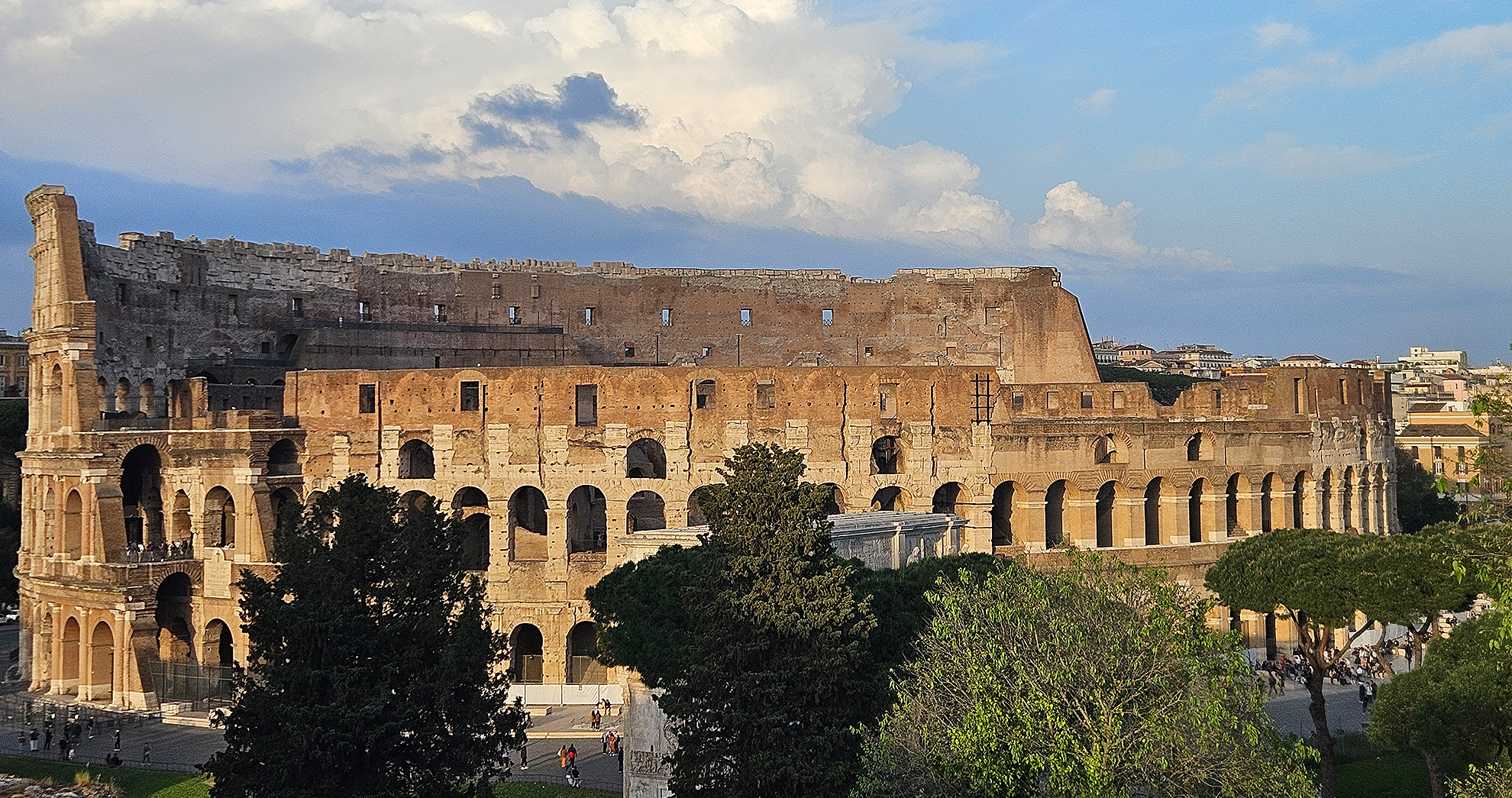
It goes without saying that the city of Rome is, moreover, an exceptional place, with a richness that is hard to imagine even for those who have already stayed there, and which can only be fully appreciated over time through its ever-changing surprises.
New prospects for the future
For Alessandra Sarti, “the development of scientific links and collaborations between France and Italy is of particular interest”. This interest is shared by Alfonso Sorrentino, with whom the researcher has drawn up the objectives for their terms of office. “Our main aim is to strengthen the partnership with our parent organisations – the CNRS, INDAM and CNR – to encourage interdisciplinary initiatives, to support mathematicians at the start of their careers, and to raise the public and institutional profile of Franco-Italian mathematics,” she summarises. The pair are also planning a ‘Hypatia Conference’, an annual symposium featuring two invited lectures, organised by an INdAM unit. They also wish to continue supporting the organisation of seminars led by researchers based at the LYSM, and to promote the mobility of scientists through annual calls for applications.
This project has already received the full support of the laboratory’s three sponsoring bodies and, to achieve this, they plan, amongst other things, to strengthen links with other institutions, notably with the embassies and French institutions in Rome – such as the École française de Rome, the Académie de France and the Lycée Chateaubriand – and Italian institutions in Paris.
During 2027, the laboratory plans to hold an inaugural conference to mark its renewal, featuring scientific presentations and attended by representatives from the three governing bodies.