A week of mathematics among high school girls: this is the project of Les Cigales, a thematic school run by the International Center for Mathematical Meetings (Cirm). An introduction to a world of enthusiasts, combining research, scientific presentations, and walks in the calanques.
What motivates us is seeing the powerful impact this week has on these young girls, how they say they feel transformed and more confident. This impact goes beyond mathematics!
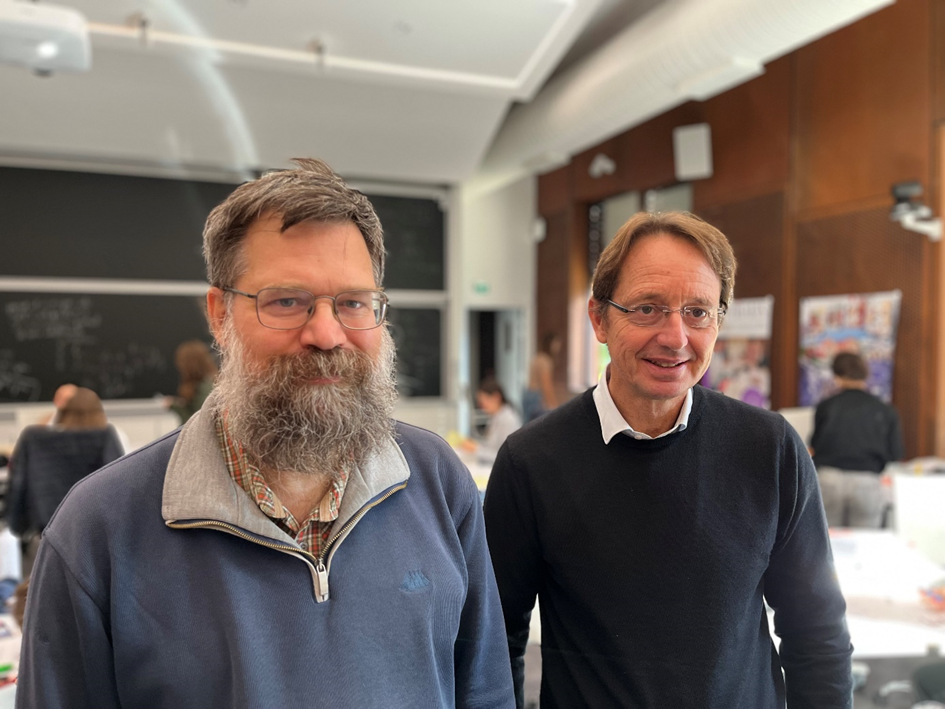
Pascal Hubert, Director of CIRM and co-founder of Les Cigales
A team of passionate individuals deeply committed to sharing and passing on knowledge
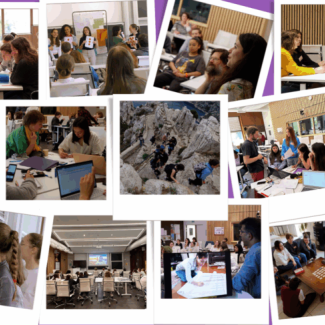
From October 20 to 24, 2025, the International Center for Mathematical Research (Cirm) hosted the eleventh edition of Les Cigales, a mathematics camp exclusively for high school girls. Since 2019, these courses, which became biannual in 2020, have already brought together nearly 250 high school girls during the spring and fall school vacations. A week to do mathematics, but also sports, meet researchers, walk in the calanques, talk with doctoral students, and discover other math enthusiasts of the same age.
For this eleventh edition of Les Cigales, the 27 high school girls taking part come mainly from the Marseille region, with a few participants from further afield. When Les Cigales was launched, they came from all over France. For the 2025-2026 school year, around 100 applications have been submitted for fewer than 30 places per course.
“Teachers are mainly informed via a network that we have built up over the years, and we would like to reach more schools,” explains Julien Cassaigne, CNRS research director and co-founder of Les Cigales. The program has evolved since 2019 and now includes fewer scientific presentations and more free time to lighten the days.
Mornings are dedicated to small-group research workshops, while afternoons alternate between outdoor team-building activities (sports, hiking, visits) and scientific presentations to introduce participants to research careers. The team also tries to vary the topics of the presentations: astrophysics, neuroscience, science and society, etc. However, the structure remains the same. “Cirm—with its all-inclusive offering—is particularly well suited to this type of event: the hotel, restaurant, and lecture halls on site allow for total immersion... And of course, the calanques are the icing on the cake!” says Pascal Hubert with a smile.
While the organization and facilitation team is mixed, the speakers are mainly women so that high school girls can identify with them and envision a future career in science. Laure Ciesla, a researcher at the Laboratoire d'Astrophysique de Marseille (LAM), Mathilde Aguiar, a doctoral student in artificial intelligence at Université Paris-Saclay, and Liana Heuberger, a lecturer in algebraic geometry at Aix-Marseille Université, presented their research and careers at this latest edition.
The idea is that participants can develop the same sensations as during research: finding things, coming up with ideas for constructions, thinking about counterexamples.
Julien Cassaigne, CNRS researcher, co-founder of Les Cigales
The high school students choose one of the research topics presented at the beginning of the week by the supervisory team, and then work in small groups throughout the week. “We are a team of passionate individuals who are deeply committed to sharing and passing on knowledge,” says Julien Cassaigne. Each supervisor is responsible for one or two groups, depending on the topics chosen. For Julien Cassaigne, “by working in groups on the same issue, the participants are immersed in the very heart of research: they think together, share their ideas, make mistakes, start again, etc.”
Among the week's visits, the high school students discover the unmissable Cirm library: “What is so special about mathematics, why do we need dedicated libraries?” This is the question with which Nathalie Granottier, head of the library, opens the visit and presents—amidst ancient works—a journey through the land of mathematics across time. The library is also where the posters created by the Cigales at the end of the week to present their research work are archived (and posted online).
Another essential step in the initial organization of the internship is the non-scientific supervision of the participants: this involves recruiting someone capable of managing a group of young people on a daily basis
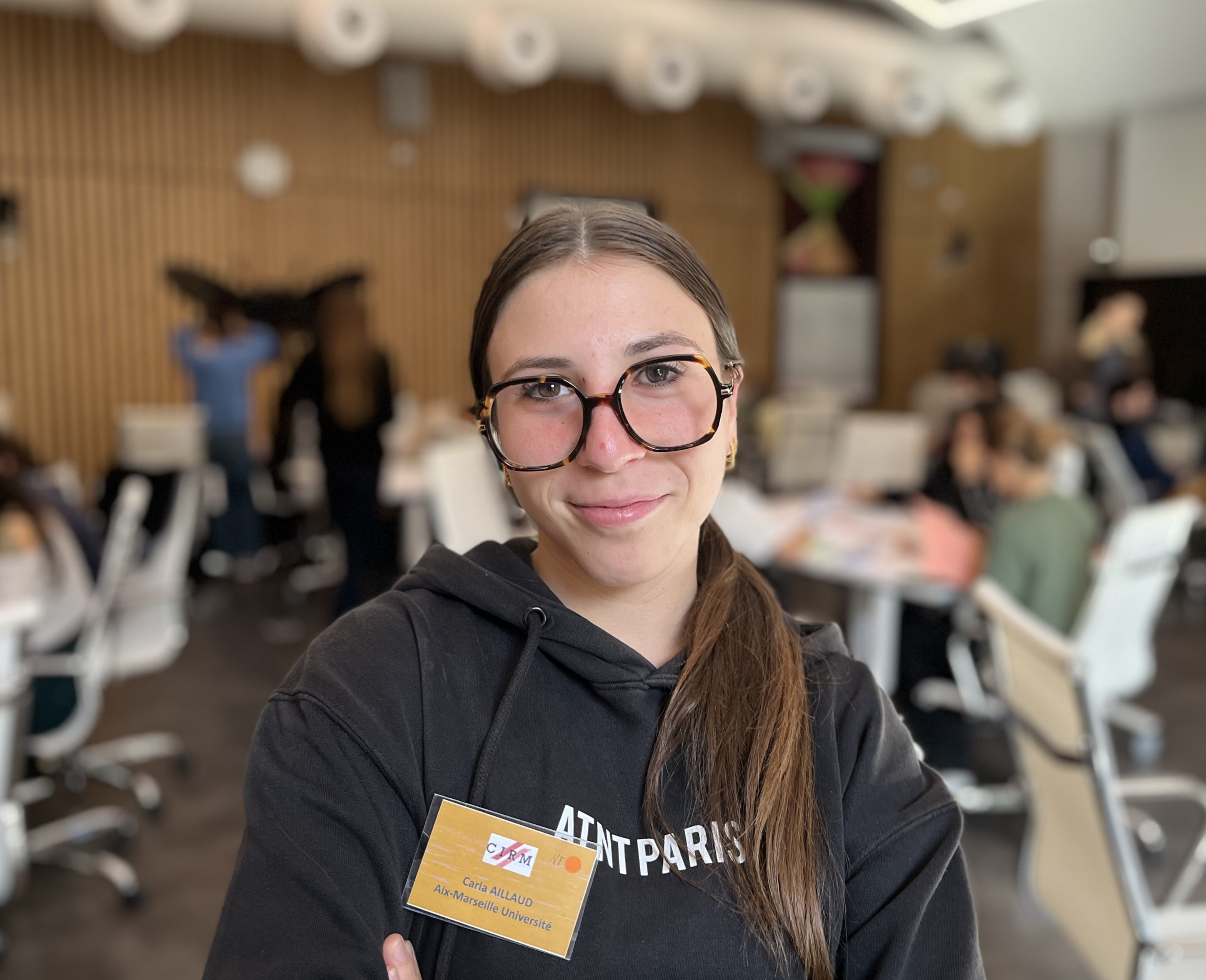
Carla Aillaud is a third-year student in sports science at Aix-Marseille University and holds a BAFA diploma. She is the coordinator responsible for the non-educational supervision of Les Cigales. She found out about the group through word of mouth and discovered a world of passionate people: "It's the first time I've met people who are really enthusiastic about science and math, and at such a young age! They are high school students and already talk about the beauty of mathematics. Very few are there because their parents asked them to be. Before my first session, I had preconceived notions about this group, which seemed very studious. But then I discovered that we had many things in common, that we could easily joke and talk together. The Cigales are high school students like any others, really; they just have a passion for math that I don't have."
Taking the time and making space
Three teachers from the science preparatory classes for the grandes écoles (CPGE) at the Lycée Général Pierre de Fermat in Toulouse came to observe for a week, with the idea of starting a math club at their school. Stéphanie Vareilles, Cirm's communications manager and a major contributor to promoting this initiative, referred them to Houria Lafrance, who is working on creating Les Abeilles, a course based on the Cigales model but this time in Occitanie, with the first edition scheduled for fall 2026.
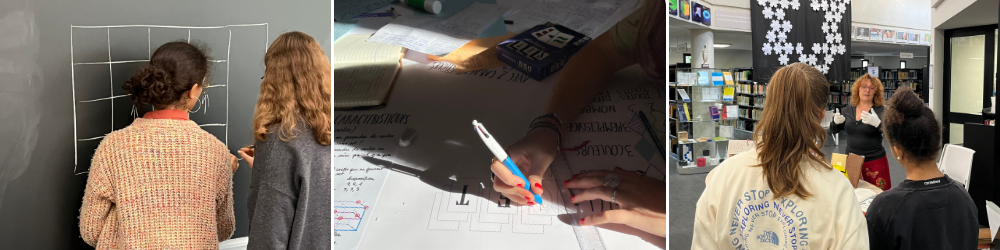
The observers from Toulouse note that the layout of the room is particularly conducive to calm and motivating work: they can create small groups, work in a soundproof room, and have access to large chalkboards. “In my work, I've noticed that going to the board is often intimidating for students, especially girls,” explains one of the teachers. “Here, they can use large chalkboards and they have taken full advantage of them. We see them in groups dividing up sections of the boards, thinking together, without fear of being seen or judged for what they write.”
In their school career, students are often pressured by various demands: the curriculum, grading, the pace of the class... here, they can take their time. It's a rare opportunity for reflection, where trainees set themselves daily goals without necessarily having to achieve them. Every day during the week, a small group work session called “research time” is dedicated to these unprecedented moments of prolonged reflection.
“That's it! That's the right one, and on the first try!” exclaims a group working on the game Dobble. Manon Stipulanti, a researcher at the University of Liège and the group's facilitator, arrives at their table with a different feeling: “Wait, I think there's a small mistake. Let's take a look together.” The group then reconsiders their recent progress. " We can also look at each symbol and see which line it corresponds to," explains Manon, and the group gets back to work together, each member exploring a different avenue, freely suggesting other ideas and writing down new calculations. This is how the mornings unfold, between exploration by the working groups and discussions with the supervisory team, made up of (post)doctoral students and researchers.
“If you're here, it's because you're already very interested in science, and particularly math.”
The two teachers and the science CPGE teacher are invited to give a brief presentation on how preparatory classes work. “If you're here, it's because you're already very interested in science, and particularly math,” one of them begins. “There are many ways to pursue careers related to science. One of the systems that exists, a starting point that leads you to a career in science, is preparatory classes. What we can encourage you to do is attend open houses during the school year, visit schools, universities, student fairs, and above all, talk to the teaching staff.” A few questions came up about the workload and homework, which were confirmed to be relatively heavy, but also about choices for further study. The high school students were then encouraged to “dare to make choices: at some point, you're going to decide to take the plunge and delve deeper into certain subjects. But if you enjoy it, you'll see that you have the inner resources you need to do it.” “The only mistake is to decide in advance that there is a wall in front of you,” concludes one of the teachers.
By the fourth day, the groups have already made good progress with their research. They write on the board and exchange ideas freely with the supervisory team, with whom they are becoming closer every day. This ease comes gradually over the course of the week: “Sometimes they wait, especially when they decide to use the board,” explains Julien Cassaigne. “Especially at the beginning, we have to guide them a little and tell them what to do, for example, to take notes on their progress.”
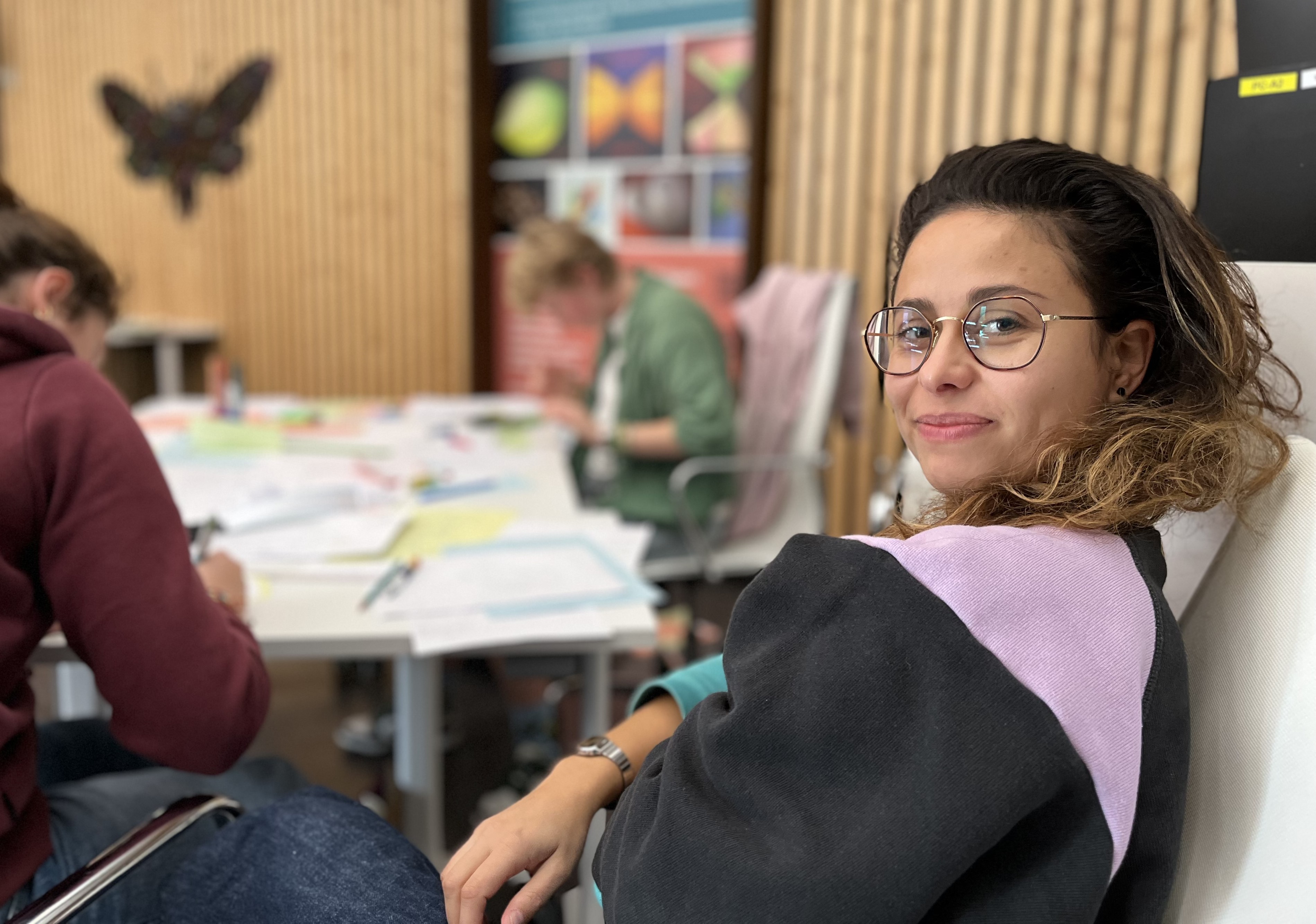
On Thursday evening, three alumni from the first edition of Les Cigales were invited to present their career paths since graduating from Les Cigales in 2019. Jeanne, an engineer who graduated from the University of Technology of Compiègne with a degree in Urban Engineering, Clémentine, an engineer who graduated from the National Institute of Applied Sciences (INSA) in Lyon with a degree in Electrical Engineering, and Emna, currently in her fifth year of medical school after earning a bachelor's degree in Ocean Physics.
In 2019, a week before the All Saints' Day holidays, the three young women's math teacher suggested they spend a week doing math in the Calanques. “Since we were three friends, we accepted,” explains Jeanne. “And we saw how jealous our boyfriends were!” adds Clémentine. What fundamental things did they discover about mathematics during Les Cigales? “Searching even when you're not sure you'll find an answer,” replies Jeanne. "In prep school or in my current job, the solution isn't always obvious and there's no ready-made method. Les Cigales taught me to think as part of a group and not to dramatize the fact that I hadn't found a solution. Because the thought process is just as interesting.“
Clémentine adds: ”I've never found a research environment like Les Cigales: working on difficult problems while being able to exchange ideas with specialists who can provide us with answers." And, of course, their encouraging perspective on women in science is only reinforced: “In our senior class, there were only two girls. But I was proud to be there! After Les Cigales, my pride grew even stronger,” comments Clémentine.
There were only two girls in our senior class. But I was proud to be there! After Les Cigales, my pride grew even stronger.
Clémentine, Alumni of the first edition of Les Cigales
Future prospects
“In June 2025, we celebrated the anniversary of Les Cigales, the tenth edition of the school, and organized a round table discussion entitled ‘What has become of them?’ with alumni,” Pascal Hubert points out. “Their contributions were very moving and reminded us why we do all this and why we must continue and further develop this initiative .” Aware of the impact of this school and the road still ahead, Pascal Hubert, along with Isabelle Chalendar and Merieme Chadid, are launching an edition on Reunion Island, scheduled for May 2026. This new cousin of Les Cigales will be organized in the lodgings of the MAKES observatory. “The fact that Les Cigales is developing throughout France and beyond reflects a real need and the usefulness of these courses. I am delighted that others are taking it on!”, explains Pascal Hubert.
The Cigales School is celebrating its tenth anniversary on Saturday, June 7, 2025, and is organizing a scientific, cultural, and festive event with some 60 Cigales alumni, along with the…
Eleven editions later, full board participation is still free for high school girls. The Cigales School of Mathematics and Computer Science exists thanks to the support of numerous partners and now benefits from Amidex funding from Aix-Marseille University, which will cover future editions until 2027. Securing long-term funding is important so that the team does not have to add grant applications to its list of tasks, as this is a very time-consuming workload. Apart from Carla (a paid facilitator), the organization and smooth running of the course relies on a team of entirely volunteer supervisors. “For this fall edition, the Marseille team was joined by a mathematician from the University of Liège and a computer scientist from Paris-Saclay,” says Pascal Hubert,who points out that without this wonderful team, Les Cigales would not exist!
High school students take advantage of research time to tackle large chalkboards. The trip also includes a detailed tour of the Cirm library, led by Nathalie Granottier [photo on the right].
It is clear in medicine that specialties are gendered. Typically in surgery, you feel the normalized sexism in hospitals. But I feel that this is changing, particularly in Marseille. I won't hold it against them: it's my specialty, it's my life, and I'll choose as I see fit.