France-Vietnam cooperation: new momentum for the IRL FVMA
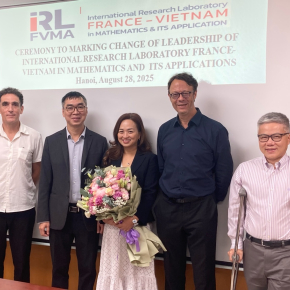
Created in 2023, the France-Vietnam International Research Laboratory in Mathematics and Applications (IRL FVMA) extends and intensifies a long-standing scientific cooperation between the two countries. The successor to the 2011 Formath Vietnam International Associated Laboratory, the IRL draws on a particularly active training and research ecosystem in Hanoi and Ho Chi Minh City. In September 2025, it welcomed a new director, Phan Thi Ha Duong, who succeeded Ngô Bảo Châu, winner of the 2010 Fields Medal and director of the laboratory since its creation.
Strong historical ties between the two countries
“Despite the vicissitudes of history, the education and research system in Vietnam has always maintained links with the French system,” says Marc Peigné, professor at the Institut Denis Poisson
Under the leadership of its coordinators (Nguyen Thanh Van, Frédéric Pham, Jean-Pierre Ramis, and finally Lionel Schwartz) and with the support of several Vietnamese institutional partners such as the Vietnam Academy of Science and Technology, Hanoi University of Education, and the University of Science of the National Universities in Hanoi and Ho Chi Minh City, the program has rolled out and structured numerous activities covering a broad scientific spectrum. “Historically, northern Vietnam has been more interested in fundamental mathematics, while the south has focused mainly on mathematics that is perhaps a little more applied,” summarizes Marc Peigné. “It was following the pioneering work of Alain Pham that cooperation with the south really took off in the 2000s, with the strong involvement of researchers Michel Zinsmeister and Duong Minh Duc.”
A new milestone was reached in 2011 with the creation of the Laboratoire International Associé Formath Vietnam (LIAFV), headed successively by Lionel Schwartz and Jean-Stéphane Dhersin, both of whom are deeply committed to cooperation between France and Vietnam. An agreement was signed with the Vietnamese Institute of Advanced Studies in Mathematics (VIASM) to support the laboratory's activities, while a generational renewal of researchers took place on the Vietnamese side, reflecting the growth brought about by this new structure.
In 2023, the laboratory evolved once again to become the France-Vietnam Laboratory of Mathematics and Applications, headed by Professor Ngô Bảo Châu. He was accompanied by a Vietnamese deputy director, Le Minh Ha, and a French deputy director, Marc Peigné.
Scientific focus, laboratory life, and priorities for the future
The IRL FVMA focuses its research on four main themes: AGT-DM (algebra, geometry, topology, discrete mathematics); analysis and applications, scientific computing; optimization and control; probability, statistics, finance. “These themes are not exhaustive and new themes are encouraged,” says Marc Peigné. In 2027, the laboratory will host an international conference on mathematical physics (ICMP).
The laboratory organizes a wide range of scientific activities. As the deputy director summarizes, "the IRL FVMA supports research visits in France and Vietnam, master's degrees, and focuses on thesis supervision. It promotes the development of conferences and summer schools and supports CIMPA schools ." Thematic workshops and schools are organized regularly, bringing together researchers from Vietnam and France, as well as Japan, Singapore, and Korea, and other European countries such as the United Kingdom and Germany.
Testimonial from Kilian Raschel, Research Director at LAREMA
I discovered Vietnam in 2018, while teaching a course on Markov chains for the France-Vietnam Master's program in applied mathematics in Ho Chi Minh City. I was struck by the magic of Vietnam's streets and the inspiring atmosphere of its universities, and I was already leaving on the evening flight, flying over the rooftops of this energetic city that never sleeps. It was on this occasion that I met Viet Hung Hoang, who came to Europe in 2019 to complete his thesis, jointly supervised by the University of Tours and the University of Münster in Germany. This human and scientific encounter led to a lasting friendship and collaboration, one example among many of cooperation between our two countries. Viet Hung Hoang now holds a position as a lecturer at the Industrial University of Ho Chi Minh City.
In 2024, my family circumstances allowed me to spend six months in Vietnam, thanks in particular to my wife, a teacher, who was able to work part-time on an annualized basis. Landing in Vietnam, this time in Hanoi, was a complete change of scenery. We got off the plane and were immediately enveloped by warm, humid air. In the taxi, we discovered extraordinarily dense vegetation and sensed a country developing at an exponential rate.
During my few months of affiliation with the France-Vietnam Laboratory, I worked mainly at VIASM, which is an umbrella organization for mathematical research in Vietnam. It is a recent building, not far from the Temple of Literature and Ho Chi Minh's mausoleum. The modern Laurent Schwartz amphitheater hosts the many events that punctuate scientific life at VIASM. I received a wonderful welcome from several colleagues, including Le Minh Ha, the deputy director of VIASM (the director is none other than Ngô Bảo Châu, winner of the 2010 Fields Medal!) and Ngo Hoang Long, a very active probabilist colleague from Hanoi National University of Education. The France-Vietnam International Laboratory is also linked to VAST, the Vietnam Academy of Science and Technology. Unlike VIASM, VAST is located on a university campus, with several leading research teams, for example in probability (my research topic). One of the highlights of my stay was the organization of a winter school entitled “Representation Theory and Combinatorics Tools in the Study of Some Probabilistic Models.” Around sixty Vietnamese and international participants attended the courses and lectures, with an equal number of French and Vietnamese speakers. Towards the end of my stay, I was invited to give several research presentations, notably in Ho Chi Minh City and Da Nang, in central Vietnam.
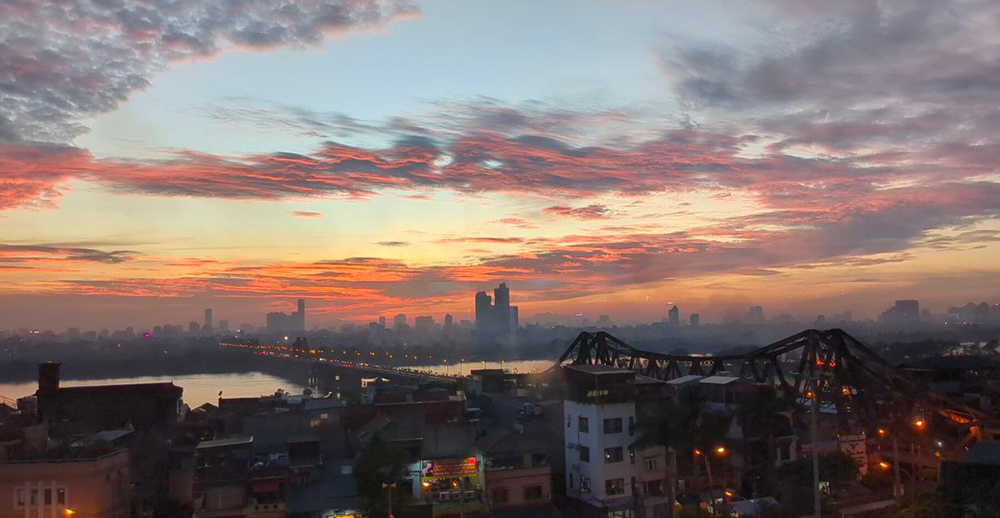
On the family side, we decided to make the most of the experience by avoiding the expat district of Hanoi and instead settling in the Long Bien district. “Long Bien” means the dragon's border, in other words, the other side of the Red River, which flows through Hanoi. Every day, as a passenger on a motorcycle taxi, I crossed the Red River on a bridge steeped in history, the Long Bien Bridge, which was inaugurated in 1903. Traveling in Vietnam is also a journey back in time, a necessary immersion in the French colonization of Indochina and its many historical landmarks in Hanoi, such as the central prison, the Hanoi Opera House, and St. Joseph's Cathedral. Also steeped in history, the so-called Reunification Train connects the south (Ho Chi Minh City) to the north (Hanoi); I had the chance to take it between Da Nang and Hanoi, a slow and inspiring journey through lush nature. The French high school is located in the Long Bien district; for our three children, this expatriate school experience was a unique opportunity to meet Vietnamese and international classmates, with a shared sensitivity and interest in French culture.
I would like to end this short account by sharing a few personal memories. When you leave VIASM, you come across a multitude of small, welcoming, traditional restaurants. You weave your way through the scooters, cross a street, and enter a 12th-century Buddhist temple, the Chùa Láng pagoda. Lost in meditation and the serenity of the place, you look up and the modern buildings towering above remind you that you are in the Vietnamese capital. That's a bit like my experience of Vietnam: a surprise around every corner, an invitation to be flexible in your thinking. This poetry of everyday life naturally found its way into my research and into the various collaborations I established with my Vietnamese colleagues. I also have vivid memories of lunch breaks at VAST: after a delicious lunch in the local canteen (for 40,000 VND, or less than €2), we would start frenzied games of table tennis, then attend a research presentation, sweaty but immediately back in a studious mood.
This stay was therefore extremely enriching and forward-looking: in September 2025, I will welcome Ngo Hoang Long to the University of Tours, then in June 2026 my former student Viet Hung Hoang. In 2027, I will co-organize a satellite school of the World Congress of Mathematical Physics in Hanoi, focusing on probabilistic aspects of mathematical physics. I sincerely hope to have another opportunity to spend a second long stay in Vietnam in the future!
I would like to express my sincere thanks to the CNRS, in particular the Insmi and the IRL France-Vietnam, for their administrative and human support throughout my stay and its preparation. I would also like to thank the entire VIASM administrative team for their availability and efficiency.
For the laboratory, the priorities for the future are clear: to develop modeling, probability, and statistics, while strengthening Vietnam's local and international mathematical foundations. “The Ho Chi Minh City Master's program has a special role to play in this context, in order to develop direct interactions between mathematics and, so to speak, the real world,” explains the deputy director. The IRL FVMA is continuing the momentum built up in the 1990s: identifying and supporting talent, structuring career paths and relationships, strengthening international collaborations, and opening up new areas of research to consolidate, over the long term, the scientific bridge that exists between France and Vietnam.
To move forward on this path, a handover will take place in September 2025: Phan Thi Ha Duong, a mathematician based in Vietnam with strong ties to France, will succeed Ngô Bảo Châu. Her presence on site throughout the year and her strong involvement in the Vietnamese scientific community will enable the IRL FVMA to strengthen its roots and open up new prospects for cooperation, both nationally and internationally. “A new page remains to be written,” concludes Marc Peigné.

A few words from the new director, Thi Ha Duong Phan

For me, this responsibility consists of maintaining and developing the laboratory. It is a demanding task, which presents both opportunities and challenges. The first opportunity lies in natural affinities: France and Vietnam share a long mathematical tradition, and in both countries, mathematics is deeply respected and valued. The second opportunity comes from the privileged cooperation between the French and Vietnamese mathematical communities. Most of Vietnam's leading mathematicians have collaborated with France. These collaborations gave rise to the PICS program, the LIA ForMath, and then in 2023 the IRL FVMA, the most advanced form of cooperation within the CNRS.
But there are also many challenges: many young talents choose other paths, either by leaving mathematical research or by pursuing their careers abroad. To meet these challenges, we must fully mobilize our assets.
First, VIASM is constantly expanding its activities, attracting a growing number of international researchers. Second, the Institute of Mathematics at VAST is strengthening its regional cooperation programs, notably through the UNESCO Mathematics Center. In addition, the University of Science and Technology in Hanoi has launched a bachelor's degree in applied mathematics and will launch a master's degree in mathematics this year. At the same time, mathematics has always been an important scientific discipline, but today it is demonstrating even more its role and applications in other areas of cutting-edge research.
I hope that the IRL FVMA's programs will be aimed not only at researchers from institutes but also at university lecturers and researchers, in order to broaden opportunities for cooperation. I also hope that we will view collaboration with other institutions not as competition, but as a partnership that will enrich our activities and foster new collaborations.
Find out more:
- See the call for applications for long-term stays at the IRL FVMA in 2026 and 2027 – Deadline: October 15, 2025