
Mathematician Hong Wang awarded the 2026 Fields Medal
Hong Wang, aged 35, is a tenured professor at the Institut des Hautes Études Scientifiques (IHES), where she is member of the Alexander Grothendieck Laboratory1, and a professor of mathematics at the Courant Institute at New York University (NYU). She has become the third woman to be awarded the Fields Medal, one of the two most prestigious honours in mathematics worldwide. This honour, which was awarded to her at the International Congress of Mathematicians in Philadelphia on 23 July 20262, recognises her exceptional work and, in particular, her proof of the Kakeya conjecture in three dimensions, published with her co-author Joshua Zahl in 2025.
From China to France: an exceptional career with an international focus
Born in 1991 in Guilin, China, Hong Wang obtained her bachelor’s degree in mathematics at Peking University before continuing her studies in France at École Polytechnique. She received her engineering degree there in 2014, whilst also completing a master’s degree in mathematics at Paris-Saclay University. During these years, she forged lasting ties with the French mathematical community. She then continued her academic career in the United States, earning a Ph.D. at the Massachusetts Institute of Technology (MIT) under the supervision of Larry Guth, a specialist in harmonic analysis. After defending her thesis in 2019, she completed a postdoctoral research at the Institute for Advanced Study in Princeton, before holding successive positions at the University of California and then at New York University.
In September 2025, Hong Wang returned to France, where she became the second woman to hold the position of tenured professor at the IHES3. “I have maintained many links with the French mathematical community since my time at the École polytechnique and the University of Paris-Saclay. It is a privilege and an honour to join the IHES, where so many of my mathematical heroes have worked and proved great theorems”, she said on her arrival. This post, held jointly with NYU, continues IHES’s tradition of maintaining close collaborations with the United States.
- 3
The first being Laure Saint-Raymond, nominated in 2021.
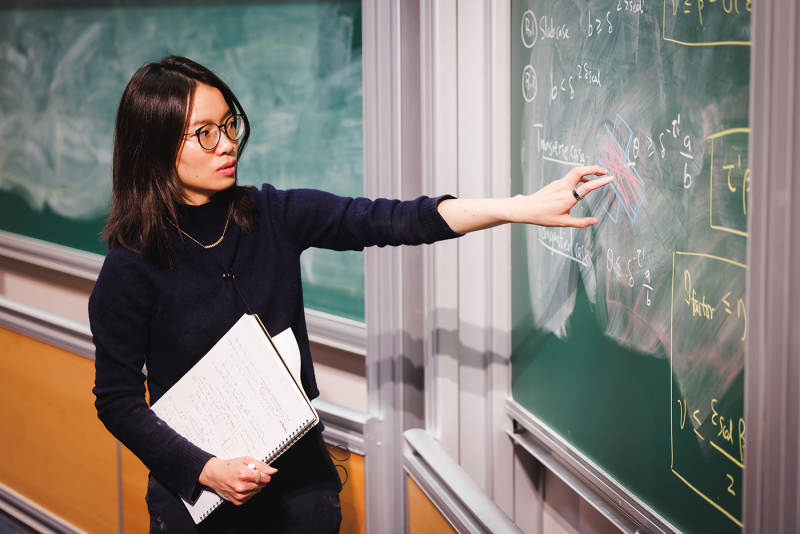
Hong Wang, professeure permanente en mathématiques à l'IHES
Hong Wang a rejoint l’IHES en tant que professeure permanente en mathématiques en septembre 2025. Hong Wang s'intéresse particulièrement à l'analyse de Fourier et à la théorie de la mesure géométrique.
Audiodescription
The Kakeya Conjecture: the resolution of a century-old problem
In February 2025, Hong Wang co-authored a 127-page paper with Joshua Zahl entitled “Volume Estimates for Unions of Convex Sets, and the Kakeya Set Conjecture in Three Dimensions”. This groundbreaking proof represents a major mathematical breakthrough: the resolution of the Kakeya conjecture in three dimensions. This problem, first formulated in 1917 by the Japanese mathematician Sōichi Kakeya, takes the form of a seemingly simple question: what is the minimum surface area required to turn a needle in every direction within a plane? In two dimensions, the answer had long been known. But in three dimensions and higher, the question had resisted mathematicians’ efforts for more than a century, until Hong Wang and Joshua Zahl provided a definitive solution to the problem in the three-dimensional case. Their proof establishes that every Kakeya set in three dimensions does indeed possess the maximum Hausdorff and Minkowski dimension, namely 3.
The proof relies on a novel method of reduction to the so-called ‘sticky’ case, identified as the key to the problem. The central argument combines several elements: volume estimates for unions of convex sets, multi-scale induction and, finally, decoupling techniques introduced by the mathematicians Jean Bourgain and Ciprian Demeter. This new framework, therefore, has captivated the mathematical community and opened up new perspectives on problems that were previously out of reach. Terence Tao, himself a Fields Medal laureate in 2006, hailed this as a historic breakthrough in the IHES Bois-Marie newsletter: “The Kakeya conjecture was the first hurdle to resolving many other problems in these fields. Now that it has been resolved, many other fascinating questions are opening up, bearing names such as the restriction conjecture, the Bochner–Riesz conjecture and the Kakeya arithmetic conjecture.”

The Fields Medal: international recognition
Following in the footsteps of Maryam Mirzakhani in 2014 and Maryna Viazovska in 2022, Hong Wang, already regarded as one of the most brilliant mathematicians of her generation, has thus become the third woman to receive the Fields Medal. This crowning achievement recognises an outstanding career and joins the list of awards she has already received throughout her career, including notably the Maryam Mirzakhani New Frontiers Prize (2022), the Salem Prize (2025), the Gold Medal of Mathematics (2025), the Ostrowski Prize (2025), the Clay Prize (2026) and, finally, the Breakthrough New Horizons Prize (2026).
This is the ninth Fields Medal awarded to a mathematician from the IHES, the twelfth awarded to a scientist from Paris-Saclay University and, finally, the seventeenth to come from a laboratory under the supervision of the CNRS. “France can once again take pride in the excellence of its mathematical research, celebrated today thanks to the work of Hong Wang, to whom CNRS extends its warmest congratulations on receiving this prestigious prize,” stresses Thierry Dauxois, Chairman and CEO of CNRS. “Hong Wang is a model of the creativity and rigor that bring honor to mathematics in France; it is a source of pride that she has joined a joint CNRS–IHES laboratory” he concludes.
Hong Wang has been awarded the 2026 Fields Medal alongside three other mathematicians: Yu Deng, Professor of Mathematics at the University of Chicago; John Pardon, Professor at the Simons Centre for Geometry and Physics at Stony Brook University; and Jacob Tsimerman, Professor of Mathematics at the University of Toronto.