


The Chained Grouper
How can we mathematically construct a model capable of predicting the evolution of a species? An article by Élise Arnaud, a researcher; Eric Blayo, a faculty researcher; and Arthur Vidard, a researcher—all three members of the Jean Kuntzmann Laboratory.

Writer's block... We promised the INSMI communications team an article for the “Maths and Oceans” series, and here we are, the three of us sitting around the table with no clear idea, just 10 days before the deadline. Something about data assimilation? Hmm, that’s pretty technical, though... Climate models? We’ve already written several articles on that...
We’re reviewing the previous articles in the series so as not to repeat what our colleagues have already said. And that’s when we were struck by a graph showing the trend in the number of groupers off the coast of Marseille over the past 20 years1. It’s very striking because it shows how the creation of the Calanques National Park in 2012 allowed the species to recover dramatically, whereas the moratorium on fishing for grouper—in effect since 1993—had barely allowed the population to remain at a low level. This is an excellent example of one of the objectives of the MEDIATION project of the PPR Ocean and Climate, in which we are participating: the design of decision-support tools for public policy. Why decide to create such a park? In exactly which area? What can we expect in terms of the evolution of marine species? What is the risk of making a mistake? These are complex questions, for which objective—and, if possible, quantitative—answers can be invaluable.
The Need for a Multidisciplinary Approach
Let’s get back to our groupers. To predict how their numbers will change in a given area, we need a relationship (a “model”), even a rough one, between the size of this population and the main factors that influence it. But what are these factors, and how do they exert their influence? This goes far beyond our very limited expertise on the subject. Hence a first lesson: on such topics, it is essential to bring together specialists from different disciplines.
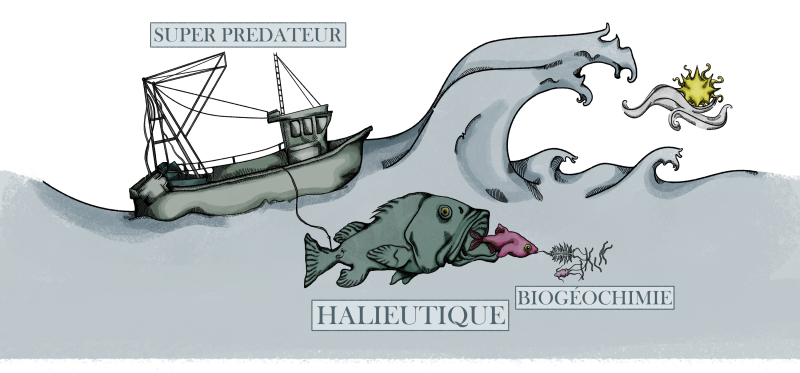
Fisheries scientists will be able to analyze what the prey are (octopuses, cuttlefish, small fish, etc.) and which predators (probably not many, aside from fishermen) the grouper has, and they will be able to build a model capable of predicting the combined trends of grouper populations and the various species with which they interact, including an adjustable parameter representing fishing mortality.
This type of representation is what is known as a “high trophic level” model: it focuses on species at the top or in the middle of the food chain.
However, the prey of our grouper also need to feed. Their abundance depends on plankton, the foundation of the food chain. To incorporate this aspect, our fisheries scientists will need to collaborate with other specialists capable of developing population models for small fish and biogeochemistry2. These models simulate the dynamics of phytoplankton and zooplankton, as well as changes in the concentration of nutrients such as carbon and nitrogen.
Finally, this entire living ecosystem does not exist in a vacuum. The distribution of nutrients and plankton is determined by ocean currents, water temperature, and salinity. It is therefore essential to anchor the entire system to an ocean circulation model developed by physical oceanographers and physicists3.
All the components needed to simulate the marine ecosystem already exist; they were designed by groups of specialists to study the processes at work in their respective fields.
- 1
Voir Le Mérou, une espèce qui compte en Méditerranée par Sébastien Simao
- 2
Voir Modélisations mathématiques de la biodiversité marine par Jean-Christophe Poggiale
- 3
Voir Mascaret, l’onde de marée par Paul Vigneaux, Comment les ordinateurs simulent-ils le littoral ? par Maria Kazakova et Arnaud Duran, et Des mathématiques pour cartographier les grands courants marins par Anne-Laure Dalibard.
A Chain of Models
Creating a comprehensive chain from these various specialized blocks raises many questions. Second lesson: we are not entirely useless, since some of these questions are mathematical or numerical in nature.
Three main challenges arise:
- The coupling of the various blocks: the technical assembly of the different models is not trivial. This raises the question of information transfer: Do the outputs of one model correspond correctly to the inputs of another (same physical quantities? same time and spatial scales?)? We must also consider the system’s dynamics: Who influences whom? In particular, do causal relationships flow in both directions?
- Choosing the level of complexity: the goal is to define the appropriate level of precision (and thus the computational cost) for each model and its interactions. This choice must be guided by the research question and the overall system being modeled, while avoiding the trap of getting bogged down in unnecessary detail. Do we really need to simulate the populations of each species at a lower trophic level separately? Is it necessary to represent all interactions—even minor ones—between models? There’s no need to use a sledgehammer to drive in a small nail (it’s even dangerous for your fingers and the nails!). An overly complex model quickly becomes a real nightmare, very costly to use and particularly difficult to calibrate.
- Uncertainty and its propagation: by combining models that are all approximations, we inevitably accumulate and propagate their errors. There are many sources of uncertainty: they can stem from the initial data, mathematical and numerical approximations, or even external forcings. These approximations do not remain isolated; an error in the temperature within the oceanographic model will skew the calculation of plankton abundance in the biogeochemical model. As this error travels up the food chain, it will cascade, combine with other errors, and potentially amplify or, conversely, disappear through a series of interactions, ultimately affecting—to a greater or lesser extent—the final estimate of our grouper population.
And what about our groupers?
Let’s apply these principles to our example. To run a simulation in a given area and predict the future of our groupers, we’ll need to link our various models together while ensuring that information flows correctly between them.
At the very beginning of the chain, we have the atmospheric model. It determines winds, air temperatures, and solar radiation, thereby driving the ocean model (current dynamics, salinity, and water temperature). At this scale, the relationship is generally considered to be one-way: the atmosphere dictates conditions to the local ocean. For a study of this type, we will use meteorological data corresponding to one or more typical years for a given climate.
This physical ocean, in turn, will influence the distribution of nutrients and plankton as represented by the biogeochemical model. Is this coupling one-way or two-way? In many cases, it is considered one-way (from the ocean to biogeochemistry), but for greater precision, one can also consider the feedback from biogeochemistry back to the ocean, since a high concentration of plankton can alter light penetration into the water—and thus its temperature.
On the other hand, between the biogeochemical model and the fish model, the two-way link (feedback) is indisputable. The biogeochemical model provides the available food, which dictates fish growth; but in turn, the fish’s appetite directly depletes the prey stocks in the biogeochemical model. The two systems are closely linked and must be modeled together.
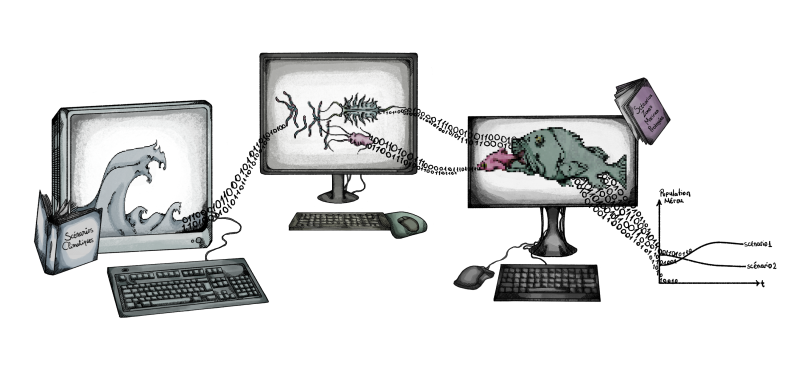
All that remains is to incorporate the ultimate predator: us (well, especially those of us who love fish). In the equations of our fish model, fishing appears mathematically as a “sink” term (it removes biomass from the system). However, this fishing intensity depends directly on management decisions, particularly the designation of protected areas where fishing is prohibited or restricted.
That is the whole point of this model chain: it allows us to run simulations based on different scenarios. The principle involves devising a policy and observing the ripple effects it has on the entire virtual ecosystem. We can thus numerically test various configurations of protected areas (their size, location, and level of restriction) and observe how our grouper population evolves without having to conduct full-scale experiments in the ocean—which would tend to annoy everyone (including the groupers) and take many years. We can also use this opportunity to study how the ecosystem adapts to climate change.
But be careful: stacking all these models together poses one final challenge: managing uncertainties. Each component (the atmosphere, the ocean, biology) has its own approximations. By coupling them, we risk seeing these small margins of error accumulate and propagate down the chain. Does that mean we should throw in the towel and declare the model useless?
Absolutely not! In science, uncertainty is not an admission of failure; it is crucial information that must be quantified. To do this, we use ensemble modeling. Rather than seeking “the” perfect prediction, we run the chain of models dozens of times, slightly modifying the initial conditions or certain parameters of the models and their interactions, within the limits of their own margins of uncertainty. In the end, instead of falsely claiming, “There will be exactly 4,322 groupers in ten years, and here is a list of their names,” we identify the factors whose uncertainty has the greatest impact and arrive at a range of possible futures. We can then tell decision-makers: “With this conservation scenario, there is a 90% probability that the population will be sustained.” Understanding, quantifying, and acknowledging these uncertainties is essential for making well-informed decisions.
We could always do better
Ideally, we could approach the problem from the opposite angle. Instead of trial and error—testing scenarios one by one—we could frame the question this way: “Here is the grouper population we want to restore within 10 years. Calculate the optimal map of protected areas to achieve this at the lowest possible cost to fishermen .” This is what’s known as an inverse problem1. It’s the ultimate decision-making tool, but with models that are so complex and interdependent—and a multitude of constraints that are difficult to describe—it’s a mathematical and computational challenge that’s infinitely harder to solve!
- 1
Voir Comment localiser les baleines dans l'océan ? par Angèle Niclas